

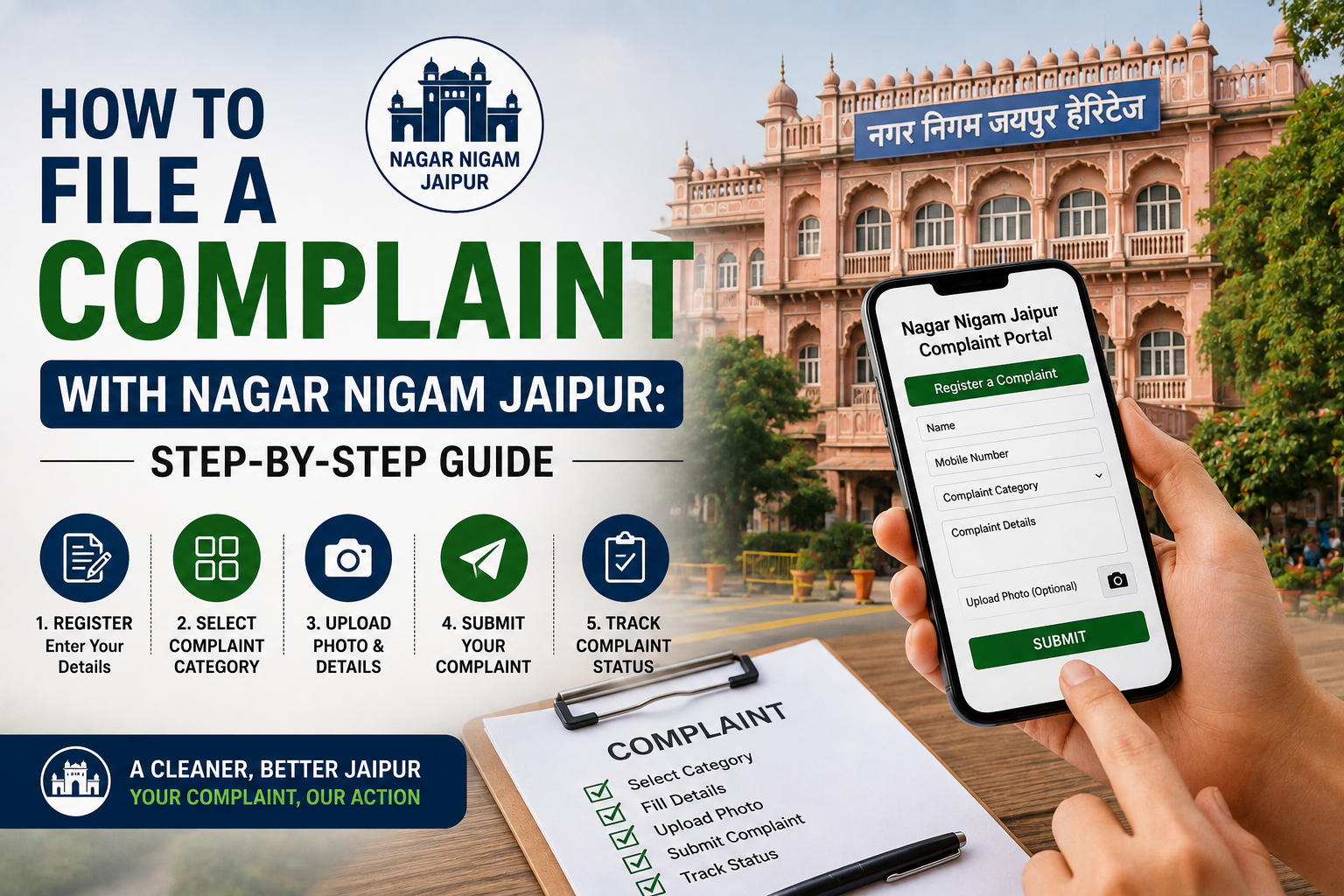
Residents of Jaipur may face various civic issues, including garbage accumulation, blocked drains, damaged roads, streetlight problems, encroachment, and unauthorized construction. Filing a Complaint with Nagar Nigam is one way to bring such issues to the attention of the concerned municipal authority. Knowing the correct procedure, documents, and follow-up steps can help residents present their grievances more effectively.
What Is a Complaint with Nagar Nigam?
A municipal complaint is a formal grievance submitted by a resident regarding a civic or municipal problem. Depending on the nature of the issue, it may relate to sanitation, waste management, drainage, roads, streetlights, encroachment, unauthorized construction, or certain property-related concerns.
Before submitting a Complaint with Nagar Nigam, it is important to identify the issue clearly and collect relevant information and supporting evidence.
Common Reasons to File a Municipal Complaint
Citizens may raise grievances regarding several civic problems, such as:
- Garbage accumulation and waste disposal
- Poor sanitation in public areas
- Blocked drains and sewage problems
- Damaged roads
- Streetlight-related issues
- Waterlogging
- Illegal encroachment
- Unauthorized construction
- Certain property tax concerns
- Other municipal service-related problems
The concerned department may vary depending on the type and location of the grievance.
How to File a Complaint with Nagar Nigam Jaipur?
Step 1: Identify the Issue
First, determine the exact nature of the problem. Note the complete location, nearby landmark, ward or zone if known, and how long the issue has existed.
A clear description helps the municipal authority understand the grievance and determine which department should handle it.
Step 2: Collect Supporting Evidence
Gather relevant evidence before submitting your complaint. Depending on the issue, this may include photographs, videos, property documents, tax receipts, municipal notices, or previous correspondence.
For example, photographs can help demonstrate garbage accumulation, damaged infrastructure, encroachment, or other visible problems.
Step 3: Submit the Complaint
Submit the grievance through the applicable municipal complaint facility or the concerned municipal office. Provide accurate contact details and explain the issue clearly.
Your complaint should generally include:
- Name and contact details
- Complete location of the problem
- Clear description of the issue
- Date or approximate duration
- Photographs or supporting documents
- Previous complaint details, if applicable
Step 4: Keep the Complaint Reference Number
After submitting the grievance, save the acknowledgement, receipt, complaint number, or reference details.
This number can be important for tracking the complaint and communicating with the concerned department later.
Step 5: Track the Complaint
Use the applicable complaint-status facility to monitor the progress of your grievance. If the issue has not been resolved, refer to the original complaint number while following up.
Maintaining records of the complaint and subsequent communications can also be helpful if additional action becomes necessary.
Step 6: Follow Up
If you do not receive an appropriate response, contact the concerned department or office and provide the original complaint reference. You may submit additional information or evidence where required.
For disputes involving legal rights, property, or formal municipal action, an ordinary grievance may not be sufficient and professional legal advice may be appropriate.
Documents Required for a Complaint
The documents required depend on the nature of the grievance. Commonly useful documents include:
| Document | Purpose |
|---|---|
| Identity proof | Establishes the complainant’s identity |
| Address proof | Helps establish connection with the location |
| Photographs or videos | Provides evidence of the issue |
| Property documents | Useful for property-related matters |
| Property tax receipt | Relevant to certain property concerns |
| Municipal notice/order | Important when official action is involved |
| Previous complaint acknowledgement | Shows earlier communication |
| Supporting correspondence | Provides a record of previous representations |
Not every complaint requires all these documents. Only relevant documents should be submitted.
Advantages of Filing a Complaint
Submitting a properly documented grievance can provide several benefits:
- Creates a formal record of the problem
- Brings the issue to the attention of the concerned authority
- Provides a reference number for future follow-up
- Allows supporting evidence to be placed on record
- Makes complaint tracking easier
- May help resolve civic problems through the administrative process
- Provides useful documentation if further action becomes necessary
A properly prepared Complaint with Nagar Nigam can therefore make the grievance process more organized and easier to follow.
When Should You Consult a Nagar Nigam Advocate in Jaipur?
Many routine civic issues can be reported directly by residents. However, certain matters involve legal rights, property interests, or formal action by municipal authorities.
A Nagar Nigam Advocate in Jaipur can assist with matters such as:
- Demolition notices
- Sealing notices or orders
- Encroachment disputes
- Unauthorized construction allegations
- Municipal property disputes
- Municipal penalties
- Disputes concerning municipal orders
- Legal representations against municipal action
An advocate can review the relevant documents, explain the available legal options, and assist with preparing an appropriate reply or representation. Professional assistance can be particularly valuable when a municipal notice contains a deadline or may affect your property or business.
Tips for Filing an Effective Complaint
Follow these practical steps when submitting your grievance:
- Clearly explain the problem.
- Mention the exact location.
- Provide accurate contact details.
- Attach relevant evidence.
- Keep copies of the submitted documents.
- Save your complaint reference number.
- Track the status regularly.
- Maintain records of follow-up communication.
- Seek legal advice when the issue involves a formal municipal notice or property dispute.
Frequently Asked Questions
1. What issues can be reported to Nagar Nigam?
Residents can report issues such as garbage accumulation, sanitation problems, drainage, damaged roads, streetlights, encroachment, unauthorized construction, and other municipal service concerns.
2. What documents are required for a Complaint with Nagar Nigam?
The requirements depend on the type of grievance. Photographs, identity or address details, property documents, tax receipts, municipal notices, and previous complaint records may be relevant.
3. What should I do if my complaint is not resolved?
Keep your complaint reference number and follow up with the concerned department. If the matter involves a legal notice, property dispute, demolition, sealing, or encroachment, consider consulting a qualified advocate.
4. When should I contact a Nagar Nigam Advocate in Jaipur?
Legal assistance may be useful when the matter involves demolition notices, sealing, encroachment, unauthorized construction, property disputes, penalties, or challenges to municipal action.
Conclusion
Filing a Complaint with Nagar Nigam can help residents report civic and municipal problems through the appropriate administrative channels. Providing accurate information, relevant evidence, and proper documentation can make the process more effective.
While routine complaints can generally be handled directly, matters involving property disputes, demolition, sealing, encroachment, unauthorized construction, or formal municipal notices may require professional legal guidance. A Nagar Nigam Advocate in Jaipur can help assess the situation and guide you regarding the appropriate legal options.