

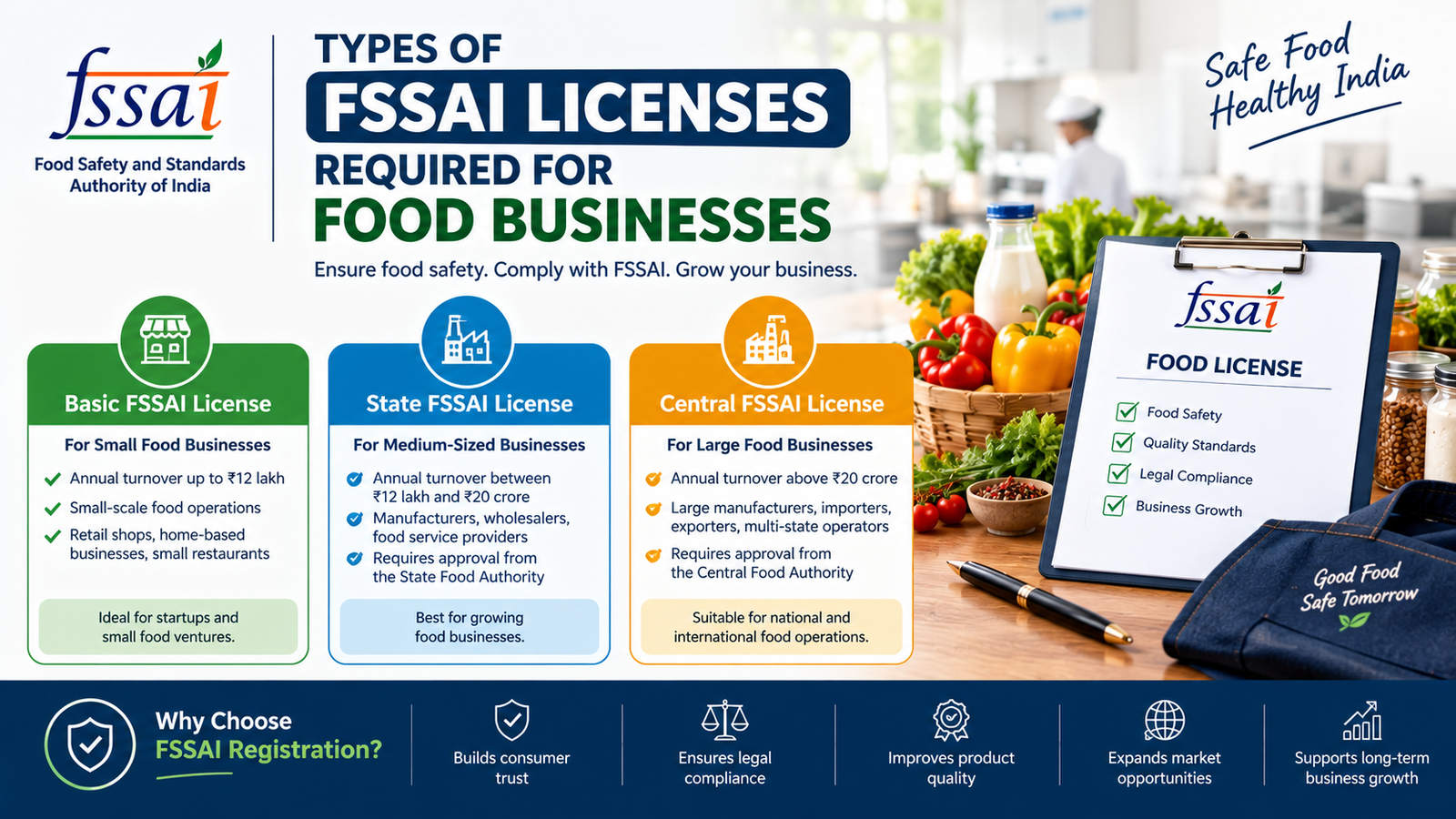
Starting a food business involves several legal and food safety requirements. Understanding the FSSAI Licenses Required for your business is an important step before beginning operations. The Food Safety and Standards Authority of India (FSSAI) regulates food businesses and provides different categories of registration and licensing based on the nature and scale of operations.
Restaurants, manufacturers, caterers, food retailers, wholesalers, distributors, cloud kitchens, and other food operators may need an appropriate FSSAI approval. Choosing the correct category helps businesses meet applicable compliance requirements and avoid unnecessary complications.
What Is FSSAI Registration and Licensing?
FSSAI registration and licensing provide regulatory authorization to eligible food businesses involved in activities such as manufacturing, processing, storage, distribution, transportation, and sale of food products.
The FSSAI Licenses Required generally fall into three broad categories:
- Basic FSSAI Registration
- State FSSAI License
- Central FSSAI License
The applicable category depends on the business activity, scale of operations, and other relevant eligibility conditions.
1. Basic FSSAI Registration
Basic FSSAI Registration is generally suitable for small or petty food businesses that meet the applicable eligibility requirements.
Businesses that may fall under this category can include:
- Small food retailers
- Home-based food businesses
- Small restaurants
- Food stalls
- Small-scale food manufacturers
- Small storage businesses
- Cottage food businesses
For eligible small operators, Basic Registration may be one of the FSSAI Licenses Required to operate a food business in compliance with applicable regulations.
2. State FSSAI License
A State FSSAI License is generally applicable to eligible food businesses operating within a particular state and meeting the prescribed criteria.
Examples of businesses that may require a State License include:
- Restaurants and cafes
- Caterers
- Food wholesalers
- Food distributors
- Medium-scale manufacturers
- Food processing units
- Retail food businesses
- Storage facilities
The exact eligibility requirements depend on the business activity and applicable regulatory provisions. Businesses should assess their specific circumstances before selecting this category.
3. Central FSSAI License
A Central FSSAI License applies to food businesses falling within specified central licensing categories. Certain large-scale food businesses and operators involved in particular activities may require this type of license.
These can include eligible:
- Food importers
- Certain large manufacturers
- Businesses involved in specified central activities
- Certain food operators working across multiple states
- Businesses covered under specified central licensing requirements
The Central License is not automatically required simply because a business is large. The applicable category depends on the nature of the business and the relevant regulatory criteria.
Comparison of FSSAI License Types
| License Type | Generally Suitable For | Main Consideration |
|---|---|---|
| Basic Registration | Small food businesses | Must meet applicable eligibility conditions |
| State License | Eligible medium-scale businesses | Generally relates to state-level operations |
| Central License | Specified businesses and activities | Subject to central licensing criteria |
This table provides a general overview. The FSSAI Licenses Required for a particular business should be determined according to its actual activities and applicable requirements.
Which FSSAI License Is Required for a Restaurant?
Restaurants generally need appropriate FSSAI registration or licensing before conducting food-related operations. The specific category may depend on the restaurant’s scale, activities, and applicable eligibility conditions.
A small restaurant may fall under Basic Registration, while another restaurant may require a State License. Business owners should evaluate their circumstances rather than selecting a category solely based on the type of business.
FSSAI Registration for Home-Based Food Businesses
Home-based food businesses, including individuals selling homemade snacks, bakery products, pickles, sauces, or other food items, may need FSSAI registration or licensing.
The applicable approval depends on the nature and scale of operations. Even a business operating from home should check the relevant requirements before selling food commercially.
Documents Generally Required
The documentation for FSSAI Licenses Required can vary depending on the category and nature of the food business. Common documents may include:
- Applicant’s identity proof
- Address proof
- Passport-size photograph
- Proof of business premises
- Rent agreement or ownership document, where applicable
- Partnership deed or incorporation documents
- Details of food products
- Information about the nature of business
- Other documents applicable to the specific activity
Providing accurate and consistent information can help reduce avoidable queries during the application process.
Why Choosing the Correct License Matters
Identifying the correct FSSAI category is important for maintaining regulatory compliance. Applying under an unsuitable category may lead to additional queries, documentation requirements, or delays.
Businesses should also review their licensing requirements when there are significant changes in their activities, premises, or operations.
For businesses needing professional assistance, a Food License Consultant in Jaipur can help with understanding applicable requirements, documentation, and the application process for Food License Registration in Jaipur.
Benefits of FSSAI Licensing
Obtaining the appropriate FSSAI approval can provide several advantages, including:
- Supports lawful food business operations
- Demonstrates commitment to food safety
- Builds customer confidence
- Helps establish business credibility
- Supports smoother business expansion
- Assists with regulatory compliance
Conclusion
The three main categories are Basic FSSAI Registration, State FSSAI License, and Central FSSAI License. However, the FSSAI Licenses Required depend on the food business’s activities, scale, and applicable regulatory criteria.
Whether you operate a restaurant, bakery, cloud kitchen, manufacturing unit, catering business, retail store, or home-based food business, understanding the appropriate FSSAI category is an important part of starting and maintaining compliant operations.
FAQs
1. What are the main types of FSSAI licenses?
The main categories are Basic FSSAI Registration, State FSSAI License, and Central FSSAI License. The appropriate category depends on the nature, scale, and activities of the food business.
2. Which FSSAI license is required for a small food business?
A small food business may qualify for Basic FSSAI Registration if it meets the applicable eligibility requirements. The exact category should be assessed according to the business’s activities and scale.
3. Do home-based food businesses need FSSAI registration?
Home-based food businesses selling food commercially may need appropriate FSSAI registration or licensing. The applicable requirement depends on the nature and scale of the business.
4. Can the FSSAI license category change if the business expands?
Yes. Changes in business activities, scale, or other relevant circumstances may require modification of an existing approval or obtaining a different category of license. The applicable procedure depends on the specific change.