

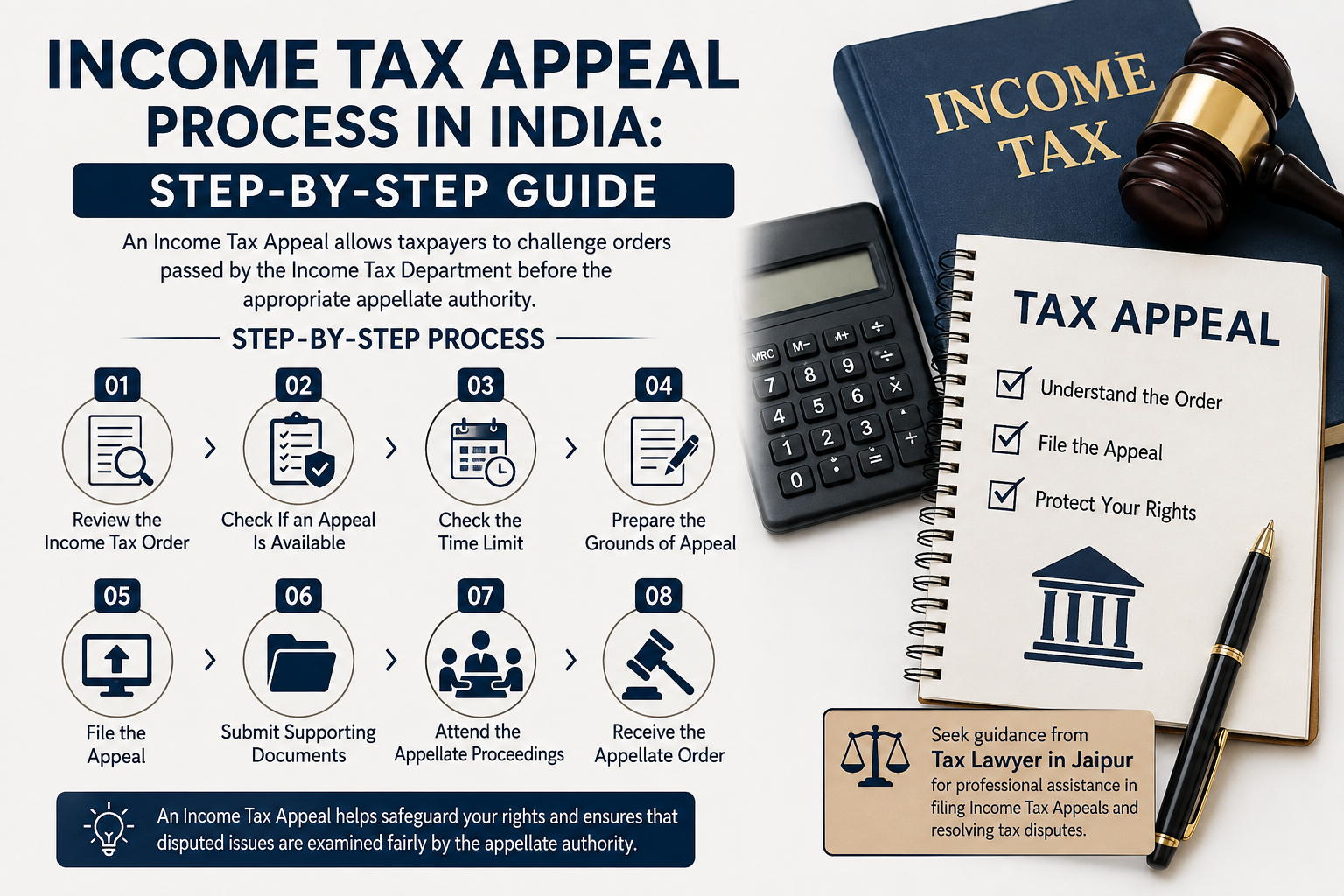
An Income Tax Appeal is a legal remedy available to a taxpayer who disagrees with certain decisions or orders issued by the Income Tax Department. It allows taxpayers to challenge an assessment, penalty, demand, or other appealable order before the appropriate appellate authority. Understanding the Income Tax Appeal process can help taxpayers take timely action and protect their legal and financial interests.
What Is an Income Tax Appeal?
An Income Tax Appeal is a formal request made by a taxpayer to an appellate authority to reconsider an order passed by an income tax authority. If a taxpayer believes that an assessment or order contains an incorrect interpretation of facts, law, income, deductions, or tax liability, an appeal may be available under the Income Tax Act.
The appropriate appellate authority depends on the nature of the order and the stage of the dispute. Common appellate forums include the Commissioner (Appeals), Income Tax Appellate Tribunal (ITAT), High Court, and, in appropriate cases, the Supreme Court.
When Can You File an Income Tax Appeal?
An appeal may be considered in situations such as:
- Disagreement with an income tax assessment
- Incorrect addition to taxable income
- Disallowance of eligible deductions or expenses
- Dispute regarding tax liability
- Certain penalties imposed by the department
- Disagreement with an order passed by an assessing authority
- Certain disputes relating to refunds or tax credits
The availability of an appeal depends on the specific order, applicable provisions, and prescribed conditions.
Step-by-Step Income Tax Appeal Process
1. Review the Income Tax Order
The first step is to carefully examine the assessment order, demand notice, penalty order, or other communication received from the Income Tax Department. The taxpayer should identify the disputed issues and understand the reasons for the decision.
2. Determine Whether an Appeal Is Available
Not every tax communication can necessarily be appealed. The taxpayer should determine whether the particular order is appealable and identify the correct appellate authority.
3. Check the Time Limit
Income tax appeals must generally be filed within the prescribed statutory period. The applicable time limit can vary depending on the order and appellate forum. Therefore, taxpayers should avoid delaying the process after receiving an appealable order.
4. Prepare the Grounds of Appeal
The grounds of appeal explain why the taxpayer disagrees with the order. They should be clear, relevant, and based on the facts and applicable law. Supporting documents and explanations may also be required.
5. File the Appeal
The appeal is filed before the appropriate authority using the prescribed procedure and applicable form. Depending on the nature of the appeal, electronic filing may be available.
6. Submit Supporting Documents
Relevant records should be submitted to support the grounds raised in the Income Tax Appeal. These may include the assessment order, income tax return, notices, financial records, and evidence supporting deductions or disputed claims.
7. Attend the Appellate Proceedings
The appellate authority may provide opportunities to present submissions and respond to the department’s arguments. The taxpayer or authorised representative may present the relevant facts, documents, and legal submissions.
8. Receive the Appellate Order
After considering the submissions and available records, the appellate authority may pass an order. Depending on the outcome and applicable law, further appeal or other legal remedies may be available.
Documents Required for an Income Tax Appeal
The documents required can vary according to the nature of the dispute. Commonly required documents may include:
| Document | Purpose |
|---|---|
| Income Tax Return | Verifies income and tax information |
| Assessment Order | Shows the decision being challenged |
| Notice received from the department | Provides details of the proceedings |
| Computation of income | Helps verify disputed calculations |
| Tax payment records | Establishes taxes already paid |
| Financial statements | Supports income and expense claims |
| Bank statements | Provides transaction-related evidence |
| Deduction-related documents | Supports eligible deductions |
| Previous correspondence | Provides background of the dispute |
Advantages of Filing an Income Tax Appeal
Filing an Income Tax Appeal can provide taxpayers with a formal mechanism to challenge an incorrect or disputed tax decision.
Opportunity to Correct an Incorrect Order
An appeal allows the taxpayer to present facts and legal arguments that may not have been properly considered earlier.
Protection of Legal Rights
The appellate mechanism provides taxpayers with an opportunity to seek review of certain decisions made by tax authorities.
Proper Examination of Disputed Issues
The taxpayer can present supporting evidence and detailed submissions concerning the disputed tax matter.
Further Legal Remedies
Where permitted by law, an appellate decision may be challenged before a higher forum on appropriate legal grounds.
Tax Lawyer in Jaipur for Income Tax Appeal
Tax disputes can involve complex provisions, procedural requirements, documentation, and strict timelines. A Tax Lawyer in Jaipur can assist taxpayers in understanding the nature of the dispute and the available legal remedies.
Professional assistance may include reviewing the disputed order, identifying appealable issues, preparing grounds of appeal, organising supporting documents, drafting submissions, and assisting with appellate proceedings.
For individuals and businesses dealing with an Income Tax Appeal, personalised legal guidance can make the process more organised and help ensure that relevant facts and legal arguments are properly presented.
Why Choose KB Sharma Legal?
KB Sharma Legal provides personalised assistance for tax-related legal matters. The focus is on understanding the taxpayer’s specific circumstances rather than following a one-size-fits-all approach.
Clients can receive assistance with:
- Reviewing tax orders and notices
- Understanding available appeal remedies
- Preparing appeal-related documentation
- Organising supporting evidence
- Drafting legal submissions
- Assistance during tax dispute proceedings
The objective is to provide a seamless and practical approach to handling tax-related legal matters.
Frequently Asked Questions
1. How much time do I have to file an Income Tax Appeal?
The time limit depends on the type of order and the appellate authority involved. Taxpayers should check the applicable statutory deadline immediately after receiving the order.
2. Can I file an Income Tax Appeal online?
Several income tax appellate procedures are available through electronic platforms. The applicable filing procedure depends on the type and stage of the appeal.
3. Can a Tax Lawyer in Jaipur help with an Income Tax Appeal?
Yes. A Tax Lawyer in Jaipur can assist with reviewing the disputed order, preparing grounds, organising documents, drafting submissions, and representing or assisting the taxpayer during applicable proceedings.
4. Can an Income Tax Appeal be filed against every tax notice?
No. The right of appeal depends on the nature of the communication or order and the applicable provisions of tax law. A taxpayer should first determine whether the particular matter is appealable.